Dojo Card Machine: Independent UK Guide for Businesses
What Is a Dojo Card Machine? A Dojo card machine is a payment terminal supplied as
Get a quote in seconds with our simple form
Last updated 22/01/2026
The acquiring bank receives a request from Stripe to authorise the payment. Stripe acts as the merchant, with its business treated as a sub-merchant, so the business does not need to set up a separate merchant account.
Then the reverse happens as the issuing bank’s decision is returned through the card network, the acquiring bank, and Stripe’s gateway. The business then informs its customer whether the payment was accepted or declined.
Please select the industry that you trade within. This information allows us to tailor your quote.
Stripe customers do not pay a monthly fee for their services; Stripe instead operates a flat-rate pricing model, meaning that its customers are only charged when a transaction is processed. This applies to online card payments, in-person payments made through Stripe Terminal, international cards, currency conversion, refunds, and disputes.
This offers simplicity and predictability to businesses, although costs do vary depending on card/payment type.
Below is a table with a comprehensive overview of Stripe’s card fees. These fees are true as of the 16th January 2026.
| Fee Type | What It Is | Fee |
|---|---|---|
| Setup fees | Account creation and activation | No setup fees |
| Monthly fees | Ongoing platform or account access | No monthly fees |
| Online card payments (standard UK cards) | Processing UK-issued debit and credit cards online | 1.5% + 20p per transaction |
| Online card payments (premium UK cards) | Processing UK-issued premium or rewards cards online | 1.9% + 20p per transaction |
| Online card payments (EEA cards) | Processing cards issued in the European Economic Area | 2.5% + 20p per transaction + 2% if currency conversion is required |
| Online card payments (non-EEA cards) | Processing cards issued outside the EEA | 3.25% + 20p per transaction + 2% if currency conversion is required |
| Link payments | Accelerated checkout using saved customer details | 1.5% + 20p (standard UK cards) \n1.9% + 20p (premium UK cards) |
| Buy Now, Pay Later (Klarna) | Instalment payments via Klarna | From 4.99% + 35p per successful transaction |
| Bacs Direct Debit | UK bank debit payments | 1% per transaction Minimum 20p, capped at £4.00 |
| Dispute (chargeback) | Handling a cardholder dispute | £20.00 per dispute received |
| Manual dispute evidence submission | Submitting evidence to contest a dispute | £20.00 (returned if dispute is won) |
| Smart Disputes | Automated dispute handling using Stripe tools | 30% of the disputed amount if won |
| In-person card payments (EEA cards) | Card-present transactions via Stripe Terminal | 1.4% + 10p per transaction |
| In-person card payments (non-EEA cards) | Card-present transactions with non-EEA cards | 2.9% + 10p per transaction |
| Tap to Pay authorisation | Authorisation fee for Tap to Pay transactions | +10p per authorisation |
| Point-to-point encryption (optional) | Additional encryption for in-person payments | +4p per authorisation |
| Card readers (hardware) | Purchase of Stripe-compatible card readers | £49.00 – £279.00 depending on machine model (excl. VAT) |
| Financial Accounts | Stripe business account with no minimum balance | Included |
| FPS funding | Funding via Faster Payments Service | Included |
| Instant payouts | Receiving funds within minutes | 1% of payout amount Minimum 40p |
| Domestic payouts | Sending money to UK recipients | 50p per payout |
| International payouts | Sending money to recipients in 50+ countries | 50p per payout Cross-border fees from +0.25% FX fees from +0.5% |
| Multi-currency settlement | Settling and paying out in additional currencies | 1% of payout volume or minimum fee |
| Instant currency conversion | Converting currencies within Stripe balances | From 0.5% of the converted amount |
| Business cards | Virtual and physical cards linked to Financial Accounts | Included No cross-border or FX fees |
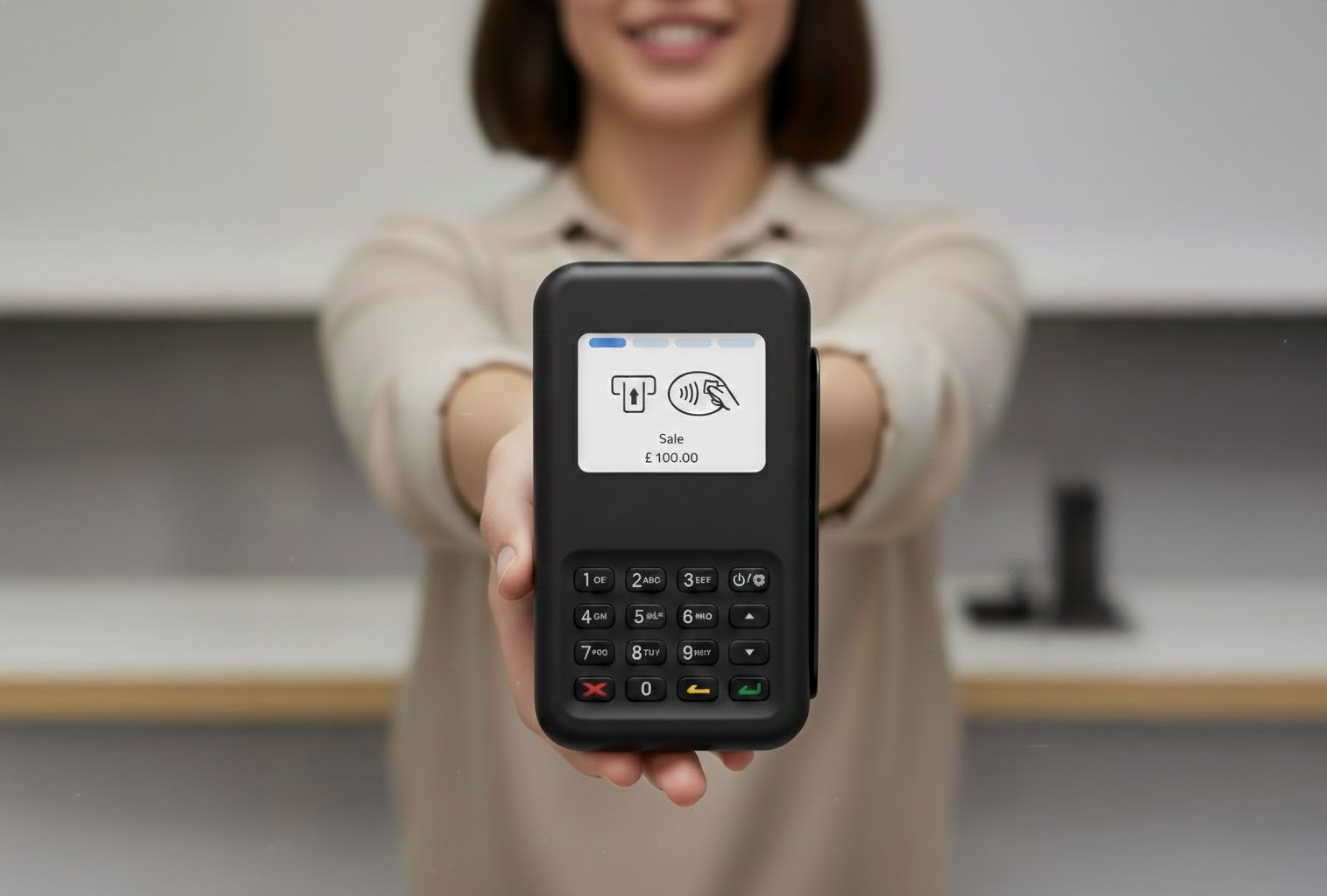
While other UK payment processors offer a standalone card machine that is rented from a payment provider, Stripe instead offers in-person payment hardware through Stripe Terminal, including Stripe card machines designed to integrate with existing systems.
Stripe does not offer rental options; all devices must be purchased outright and are designed to work alongside Stripe’s software integrations, rather than operating as fully independent terminals. This allows businesses to take both online and in-person payments through one payment ecosystem.
Stripe’s in-person payment options include:
Stripe allows its customers to accept both online and in-person payments within the same system. However, there are some nuances that potential users need to be aware of.
Online payments are also known as “card-not-present transactions.” This means there is no physical card involved in the process, and customers typically enter their payment details remotely through a website, app, or digital checkout. Online payments rely solely on software to process transactions and do not require hardware like card machines.
In-person, or “card-present transactions,” are those that take place in-person. To facilitate these payments, hardware such as a card reader or a compatible mobile device is needed.
These differences affect how payments are set up, managed, and scaled over time, even when both transaction types are handled within the same Stripe account.
A prime example of this is the risk levels that come with each payment type. Card-present transactions typically involve lower fraud risk because the cardholder and card are physically present, while card-not-present transactions carry higher fraud and dispute exposure and may require additional security measures. This then impacts the types and amount of fees paid by the merchant.
Using Stripe for both online and in-person payments can centralise transaction data and payout management within a single system. However, due to the differences in payment contexts, reconciliation and operational considerations can vary due to transaction types, payment flows, and supporting infrastructure.
Stripe helps to unify both payment types, but businesses still need to understand the difference between accepting online and in-person payments and how this will impact their decision-making and cash flow.
| Consideration | Online Payments (Card-Not-Present) | In-Person Payments (Card-Present) |
|---|---|---|
| Payment environment | Remote, digital checkout | Physical point of sale |
| Cardholder presence | Cardholder not present | Cardholder and card present |
| Hardware requirement | No physical payment hardware | Requires a reader or a compatible device |
| Fraud risk profile | Higher risk, additional verification | Lower risk due to physical presence |
| Setup | Software only | Software plus hardware and connectivity |
| Scaling and growth | Expands digitally | Adds devices, locations, and integrations |
It should be noted that payments are not instant. Depending on the payment and card type, payments will typically clear within one to three business days.
Stripe corporate cards are expense cards that are an additional service by Stripe Issuing, and they are not required to accept payments. They come in both digital and physical forms, with digital cards costing 10p per card and £3.50 (plus shipping costs) per physical card. These are designed for businesses that want to make online and in-person purchases for internal use or business expenses.
One of Stripe’s main advantages is the speed and flexibility of its setup without the need for long-term contracts or bundled hardware packages.
Their software-first approach makes it well-suited for businesses that want more customisation in their payment-taking abilities, including third-party and custom integrations.
Stripe also centralises in-person and online payments within a single system, as well as facilitating multi-currency and international payments, enabling businesses to seamlessly trade outside of the UK.
Stripe operates with standardised account oversight and support structures, meaning that smaller businesses may have limited access to dedicated account management or escalation.
Stripe may review or restrict accounts in line with its contractual, compliance, and regulatory obligations, temporarily restricting, limiting, or completely removing the ability to take payments.
While flat-rate pricing offers predictability, businesses may outgrow this pricing model when compared to negotiated or interchange-plus pricing that is offered by more traditional UK merchant account providers.
Stripe is designed to support online-first and software-driven payment models, but suitability depends on how you take payments and the industry you operate in. Certain industries are restricted or prohibited under Stripe’s policies due to regulatory, legal, and financial partner requirements.
Stripe is commonly used by:
Â
When assessing whether Stripe is appropriate for your business, consider:
Yes, Stripe allows full or partial refunds of non-disputed payments via the Dashboard or API. Refunds typically take 5–10 business days to reach the customer’s account. Processing fees from the original transaction are not returned.

What Is a Dojo Card Machine? A Dojo card machine is a payment terminal supplied as

What Are Stripe Payments? Stripe Payments is a payment processing service provided by Stripe that allows

Your business needs a card machine that’s suited to you and your customers: here’s our breakdown
CommercialExperts.com helps savvy UK businesses to save time and money by comparing a wide range of essential products and services.
© TFLI 2025 All rights reserved. Licenced by the Information Commissioners Office, (Registration Number Z3585914) Registered in the UK, number 08424810. Registered Office Address: First Floor, Beechwood Court, Springwood Way, Tytherington Business Park, Macclesfield, Cheshire. SK10 2XG.