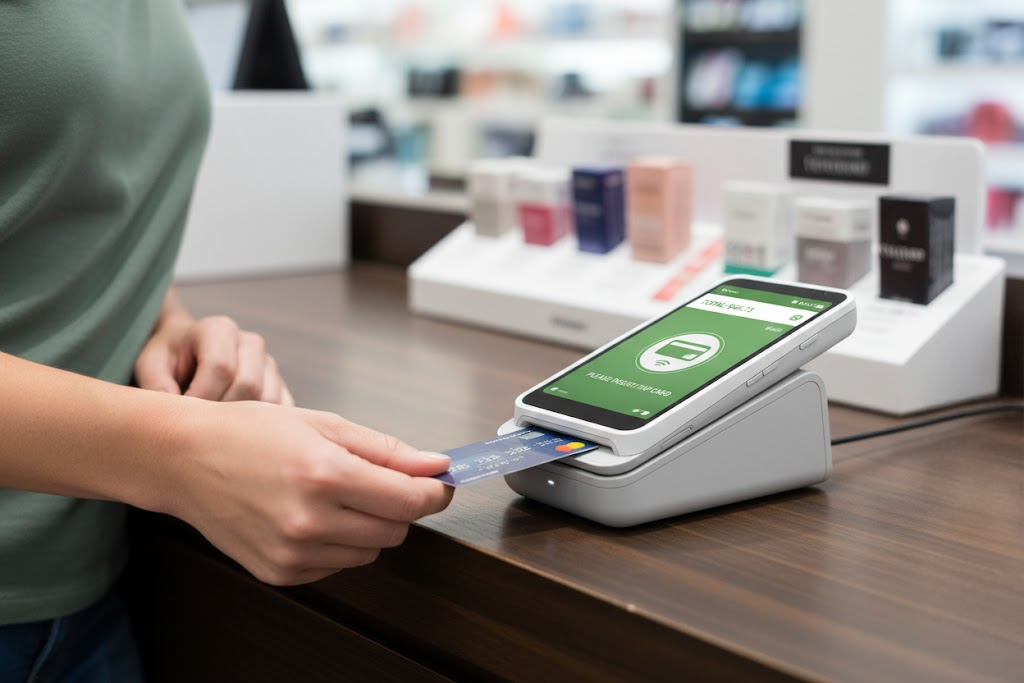
Best Card Machines For Your Small Business: 2025 Round-Up
Your business needs a card machine that’s suited to you and your customers: here’s our breakdown
Get a quote in seconds with our simple form
Last updated 15/09/2026
Last reviewed: August 2026. Fees, terms, and service availability can change, so confirm all charges in your written quote before applying.
UK businesses may pay a range of fees to process card payments. These include percentage transaction fees, fixed authorisation charges, monthly account fees, card-machine costs, PCI-related charges, and gateway or virtual-terminal fees, with additional charges for refunds, chargebacks, faster settlement, and cancellation.
Headline rates do not represent your total cost, so compare monthly card turnover, transaction volume, average value, card and payment-channel mix, and fixed monthly charges.
Use the following formula to calculate your effective card-processing rate:
Effective card-processing rate = total card-payment costs ÷ total processed card turnover × 100
Card processing fees can include recurring, transaction-based, and conditional charges. Some apply when you accept card payments, while others vary by provider, payment channels, and equipment.
| Fee | How it is charged | When it may apply | Common or conditional? |
|---|---|---|---|
| Transaction fee | Percentage of the payment value | Most successful card payments | Common |
| Authorisation fee | Fixed amount | Each attempted or approved transaction | Provider-dependent |
| Monthly account fee | Fixed monthly amount | Merchant-account agreements | Provider-dependent |
| Minimum service charge | Monthly minimum | Eligible charges fall below an agreed amount | Conditional |
| Card-machine cost | Upfront purchase or monthly rental | In-person card acceptance | Common for physical terminals |
| PCI programme fee | Monthly or annual charge | Provider compliance services | Provider-dependent |
| PCI non-compliance fee | Monthly or periodic charge | Required validation remains incomplete | Conditional |
| Payment-gateway fee | Monthly or per transaction | Online card payments | Channel-dependent |
| Virtual-terminal fee | Monthly or per transaction | Phone or manually entered payments | Channel-dependent |
| Refund cost | Fixed fee or retained processing charge | You refund a card payment | Provider-dependent |
| Chargeback fee | Fixed amount | A customer disputes a card payment | Conditional |
| Settlement fee | Fixed or percentage-based charge | Faster or non-standard settlement | Conditional |
| Cancellation fee | Fixed amount or remaining contractual costs | You end an agreement early | Contract-dependent |
Providers may bundle several charges into one transaction rate or itemise them separately. A service advertised with ‘no monthly fee’ may still carry transaction and conditional costs, while ‘from’ rates may only apply to certain cards, channels, or business profiles.
Before signing, request a written quote and full terms showing every applicable charge and any conditions involving card type, transaction method, turnover, or contract length.
When a customer pays by card, multiple parties are involved in the transaction.
Card Issuer: The company that provides the customer’s card.
Card Scheme: Provides the network to allow the transaction to be processed.
Acquirer: Enables the merchant to accept card payments.
Payment processor/payment service provider: Connects the business, the customer’s bank, and the card network.
Your provider may perform several of these roles itself or work with other organisations. Depending on your agreement, your card machine, payment gateway, processing service, and merchant account may be supplied by one or multiple different providers.
The underlying cost of a card payment can contain three main components:
Interchange: Paid within the transaction chain to the customer’s card issuer.
Scheme fees: Charged for using the card scheme’s network and services.
Acquirer or processor margin: The amount added for providing and supporting the merchant’s payment service.
You may not see these listed separately on your quote or statement, with some providers combining them into a blended rate.
An interchange fee is an underlying card-payment charge transferred by the merchant’s acquirer to the customer’s card issuer. Although it passes between financial institutions, it forms part of the cost that your provider recovers through the card-processing fees charged to your business.
In the UK, the Interchange Fee Regulation caps interchange fees on consumer card transactions where the merchant, acquirer, and card issuer are all UK-based:
These percentages are the maximum interchange fees for transactions covered by the regulation; they are not universal rates for every card payment.
Commercial and corporate cards are not covered by the consumer card caps discussed here. International and interregional transactions may also fall outside these caps, including where the card issuer or acquirer is located outside the UK.
The interchange cap is not the final rate your business pays; your total transaction charge can also incorporate card-scheme fees, the acquirer or processor’s margin, and fixed authorisation charges.
Card-scheme fees are charged for using a payment network. Operated by card schemes like Visa and Mastercard, these networks provide the infrastructure and rules needed for payment information to pass between the organisations during a card transaction.
Scheme fees are separate from interchange, and their amount varies depending on the card scheme, card type, transaction type, and the locations of the parties involved. Providers may itemise these costs separately or include them in a blended transaction rate, so they may not appear as individual charges on your quote or statement.
There is no universal card-scheme fee applied to every UK card transaction, so you should always check whether your provider itemises scheme fees or incorporates them into the quoted processing rate.
The acquirer or processor margin is the amount charged for providing merchant payment services in addition to underlying costs such as interchange and scheme fees. Depending on the provider, it may cover payment processing, account services, risk management, customer support, and the technology used to accept payments.
The margin may appear as:
An acquirer, payment processor, and payment service provider are not necessarily the same organisation. Sometimes one company will perform several roles, or separate companies may be involved. Confirm how the provider’s charges are structured, even if its margin is not shown as a separate line item.
Blended pricing, also known as flat-rate pricing, combines interchange, scheme fees, and the provider’s margin into one quoted transaction rate. This makes processing costs easier to understand than calculating each component separately.
A flat rate does not necessarily apply to every transaction, and providers may use different blended rates for:
Blended pricing simplifies charges but reduces visibility into the underlying costs and provider margin. When comparing quotes, check which cards qualify, whether commercial, international, online, and manually entered payments cost more, and whether fixed transaction or monthly fees apply.
Interchange-plus pricing passes the underlying interchange cost through to your business and shows the provider’s margin separately. Your quote should explain how scheme fees are treated.
Although this model provides greater visibility over your processing costs, monthly costs can vary with your card mix, and statements may be more complex than under blended pricing.
Interchange-plus is not automatically the cheapest pricing model. When comparing a quote, check:
Include all these costs when calculating the quote’s effective processing rate.
Debit- and credit-card payments can have different underlying costs. Where the UK interchange caps apply, fees are limited to 0.20% of the transaction value for consumer debit and prepaid cards and 0.30% for consumer credit cards.
These caps are not the final rates charged to your business. Providers may combine debit and credit costs with scheme fees and their margin into one blended rate or quote separate rates by card type.
When assessing quotes, confirm which rates apply to debit, credit, commercial, and international cards.
Commercial and business cards are not covered by the UK consumer-card interchange caps, meaning their underlying costs can differ from consumer cards. Because of this, you may be charged a different rate for payments made using business, commercial, or corporate cards.
If you accept payments from other businesses, establish how commercial cards are identified and charged, then model costs using your expected split between consumer and commercial card payments.
International cards may carry different interchange and scheme costs from UK-issued consumer cards. Cross-border charges may apply if the card issuer, acquirer, and merchant are located in different countries or regions. Currency conversion may create additional costs when you accept payment in another currency.
Although it’s easy to confuse the two, currency conversion and cross-border charges are separate costs and may be charged independently, even if they are not itemised separately on your quote or processing statement.
EEA and non-EEA cards may be priced differently. There is no universal “international card rate”, so confirm:
Card-present transactions are when a card is used at a physical terminal. Card-not-present payments are accepted without the card being physically present. These can include:
Providers may charge more for card-not-present payments because of increased risk of fraud and payment disputes. However, they are not automatically more expensive in every arrangement. Compare transaction rates alongside gateway, virtual-terminal, fixed authorisation, refund, and chargeback costs for each channel you use.
Providers may assess your business and risk profile to determine the terms of your contract. Factors can include:
These factors don’t always increase your rate. Depending on the provider and level of risk identified, they may influence your quoted margin, settlement terms, reserve requirements, contract conditions, or whether your application is accepted.
Always give providers consistent and accurate information so all quotes are based on the same business profile.
Higher card turnover may strengthen your negotiating position with providers that offer tailored pricing.
A fixed per-transaction charge represents a larger proportion of a low-value payment than a high-value payment. Monthly account, terminal, and compliance charges can have a greater effect on the effective rate of a low-volume business because those costs are spread across lower card turnover.
For a fair comparison, assess card turnover and transaction count together. Dividing turnover by transaction count gives you an average transaction value to apply to each quote.
Merchant-services quotes can contain transaction-based, recurring, channel-specific, and conditional charges. Below is a table with some of the most common fees and what to verify in your quote.
| Fee | How it is charged | When it applies | What to verify |
|---|---|---|---|
| Percentage transaction fee | Percentage of payment value | Card payments | Eligible cards and payment channels |
| Authorisation fee | Fixed amount per transaction or attempt | A payment is submitted for authorisation | Successful, declined, and reversed-payment treatment |
| Monthly account fee | Fixed recurring amount | Maintaining a merchant account | What services are included |
| Statement or administration fee | Fixed monthly or per-statement charge | Account reporting and administration | Paper and electronic statement costs |
| Minimum monthly service charge | Monthly minimum or shortfall | Eligible charges fall below an agreed amount | Which fees count towards the minimum |
| PCI programme fee | Monthly or annual amount | Provider compliance programme | What support is included |
| PCI non-compliance charge | Monthly or periodic amount | Required validation is incomplete | How to remove the charge |
| Payment-gateway fee | Subscription, percentage, or fixed transaction charge | Online payments | Included transactions and excess charges |
| Virtual-terminal fee | Subscription or per-transaction charge | Phone or manually entered payments | User limits and additional gateway costs |
| Card-machine purchase | Upfront amount | Buying in-person payment hardware | VAT, warranty, compatibility, and replacement |
| Card-machine rental | Monthly amount | Renting in-person payment hardware | Term, ownership, maintenance, and return conditions |
| Connectivity or SIM fee | Monthly or usage-based amount | Connected mobile terminals | Whether data is included |
| Setup or installation fee | One-off or per-location amount | Opening or configuring the service | Installation, integration, and training |
| Delivery fee | Fixed shipping charge | Receiving or returning equipment | Standard, expedited, and replacement delivery |
| Repair or replacement fee | Fixed amount per incident | Damaged, lost, or faulty equipment | Warranty and engineer call-out coverage |
| Refund cost | Fixed fee or retained processing charge | Refunding a payment | Whether original fees are returned |
| Chargeback fee | Fixed administration charge | A cardholder disputes a payment | Retrieval costs and successful-dispute treatment |
| Cross-border charge | Percentage or provider-defined supplement | International cards or transactions | Provider definitions for UK, EEA, and non-EEA cards |
| Currency-conversion charge | Percentage markup or fixed fee | Payment and settlement currencies differ | Conversion rate, margin, and settlement currency |
| Settlement fee | Fixed or percentage-based charge | Faster or non-standard funding | Standard timing and linked-account conditions |
| Reserve or withheld funds | Percentage or fixed amount retained temporarily | Provider risk controls | Amount, release schedule, and review conditions |
| Cancellation fee | Fixed amount or remaining contractual costs | Ending an agreement early | Notice, renewal, equipment return, and closure costs |
The percentage transaction fee is calculated against the value of a card payment and may be deducted from settlement or invoiced separately. Rates can differ between debit, credit, commercial, and international cards, as well as between in-person, online, and manually entered payments.
Check whether the advertised price is a standard blended rate, a tailored rate, or merely a ‘from’ rate. Establish which transactions qualify and what rate applies to everything else.
Providers may add a fixed charge to the percentage transaction fee, regardless of the payment value. Depending on its terms, that charge could apply to successful payments, every authorisation attempt, declined payments, or reversed transactions.
If you accept many low-value payments, fixed fees can quickly eat into your profits because they represent a much larger proportion of a £10 transaction than a £100 transaction.
A monthly merchant-account fee is a fixed recurring charge for maintaining the payment service. It may cover account administration, processing services, reporting, or support, but inclusions vary.
Confirm whether hardware rental, gateway access, support, PCI services, and transaction charges are included or billed separately.
Some providers may charge a fee for account administration or processing statements. Confirm whether electronic statements are included, whether paper copies cost extra, and whether a separate reporting fee applies.
A minimum monthly service charge is a threshold of processing charges you agree to meet each month. If you fall short, you may be charged the difference. Ask which charges contribute towards the minimum and how any shortfall is calculated.
This is particularly important for low-volume and seasonal businesses, which may regularly have to cover the shortfall.
The Payment Card Industry Data Security Standard, or PCI DSS, sets security requirements for organisations that handle payment-account data. PCI DSS does not set a universal merchant fee, but providers may charge for their compliance programmes.
Provider charges may cover compliance tools, validation support, account administration, or a security programme. Confirm whether your PCI programme fees are charged monthly or annually, included elsewhere, and optional or compulsory.
A separate non-compliance charge may apply if you do not complete the validation required under your provider’s programme. Paying the charge does not make your business PCI compliant; it is a provider-imposed charge for incomplete validation.
Because programmes vary by provider, always confirm when validation is due, how the charge is calculated, and whether completing the requirements will remove it. Check the agreement for any additional consequences of remaining non-compliant.
A payment gateway securely transmits payment information for online processing. Gateway pricing may include a monthly subscription, fixed transaction charge, percentage fee, or an allowance covering a set number of transactions.
Confirm what happens if you exceed an agreed allowance and whether your gateway costs are included in your online processing rate or charged separately.
A virtual terminal enables you to take card payments by phone or online by manually entering card details. Charges can include a monthly subscription, card-not-present transaction rate, gateway fee, or account charge.
Establish whether the virtual terminal is included, how manually entered payments are priced, how many users receive access, and whether additional users cost more.
Some providers require you to purchase hardware upfront. Look beyond the initial purchase price and check:
You may need to rent terminals and other hardware, which can involve a separate contract from the processing service. The number of terminals required and the length of your contract can impact your total hardware costs. Always establish:
Countertop equipment often relies on an established Wi-Fi or Ethernet connection, while mobile terminals may use a SIM or mobile data. Understand whether connectivity is included or charged separately and whether it covers mobile data, roaming, backup connectivity, and every terminal.
Initial charges may include merchant-account setup, terminal configuration, on-site installation, ecommerce integration, or staff training. They may be charged once at the business level or separately for each location, terminal, or payment channel. Always include these fees when comparing the first year of each quote.
Shipping charges may apply to initial delivery, replacement equipment, expedited delivery, and return postage. Confirm who is responsible for shipping fees.
Charges may apply for accidental damage, loss, theft, engineer call-outs, or emergency replacements. Coverage for equipment faults may depend on the warranty or maintenance agreement. Understand what support is included, how quickly faulty equipment will be replaced, and what scenarios make you responsible for covering the costs.
You may be charged when issuing a refund. Every provider handles this differently, and you could pay a separate refund fee, lose the original processing charge, receive part of that charge back, or face different treatment for partial refunds.
Your quote should explain both the cost of issuing a refund and what happens to the fee paid on the original transaction. Do not assume the original charge is automatically returned.
A chargeback is a card-payment dispute initiated through the cardholder’s issuer, often triggered by suspected fraud, unrecognised transactions, non-receipt, processing errors, or disagreements over goods or services. A chargeback may result in the disputed amount being removed or withheld, alongside a fixed administration fee.
Always confirm whether retrieval or information-request fees apply and whether the administration fee is returned if you successfully defend the transaction.
Cross-border charges may apply when you accept a payment from a card issued outside your region. You may be charged additional interchange, scheme, or provider costs.
Establish how your provider classifies UK, EEA, and non-EEA cards and whether card-present and card-not-present transactions receive different rates. Do not assume that there is a flat “international rate” for every card, payment type, and region.
If you accept a payment in a currency that differs from your settlement currency, you may be charged an exchange-rate markup, fixed conversion charge, or both. This is different from a cross-border charge, and international transactions can involve one or both of these fees. Confirm your settlement currency, conversion rate, margin, and whether you can receive funds without conversion.
Standard settlement is typically between one and three business days, although provider terms vary and weekends and bank holidays can affect timing. You may have options for next-day, same-day, or instant settlement, which may have eligibility conditions or an additional fixed or percentage-based charge.
Check whether faster settlement requires a linked business account and whether the advertised timing applies to every transaction.
A reserve is not a fee but part of the merchant’s processed funds held temporarily against potential refunds, disputes, or other liabilities. Providers may use rolling, fixed, or upfront reserves or delay settlement under specified conditions.
Ask what percentage or amount will be held, how long it will remain unavailable, when it will be released, and how the arrangement may affect cash flow.
Ending an agreement before your contract expires may result in early-termination fees. Depending on your agreement, you may owe:
Before signing, review the written processing and terminal contracts for their initial terms, renewal conditions, notice periods, and return requirements.
Your effective rate is the total cost of accepting cards as a percentage of your processed card turnover. Unlike a headline transaction rate, it reflects applicable percentage and fixed transaction fees, monthly account charges, terminal costs, gateway or virtual-terminal fees, PCI programme charges, and conditional costs.
Effective card-processing rate = total card-payment costs ÷ total processed card turnover × 100
Use costs and card turnover from the same period and do not divide by total business revenue if some customers pay by cash, bank transfer, or another method. Processing statements show your historic effective rate, while figures from a quote provide an estimate of future costs. Keep VAT treatment consistent between quotes.
The following examples are entirely hypothetical and do not represent UK market averages or provider prices.
This café processes £5,000 across 250 in-person transactions, giving it an average transaction value of £20, with a card mix of 80% consumer debit and 20% consumer credit.
| Cost | Hypothetical calculation | Monthly total |
|---|---|---|
| Blended transaction rate | £5,000 × 1.40% | £70 |
| Authorisation fee | 250 × £0.03 | £7.50 |
| Account, terminal, and PCI fees | £10 + £20 + £5 | £35 |
| Total processing cost | £112.50 | |
| Effective rate | £112.50 ÷ £5,000 × 100 | 2.25% |
This retailer processes £50,000 across 1,000 transactions, with an average transaction value of £50. Its card mix is 80% UK consumer cards, 15% commercial cards, and 5% international cards. It accepts 80% of payments in person and 20% online, with a monthly gateway fee included for online acceptance.
| Cost | Hypothetical calculation | Monthly total |
|---|---|---|
| UK consumer cards | £40,000 × 0.90% | £360 |
| Commercial cards | £7,500 × 1.80% | £135 |
| International cards | £2,500 × 2.50% | £62.50 |
| Authorisation fees | 1,000 × £0.03 | £30 |
| Account, terminals, PCI, and gateway | £15 + £50 + £5 + £20 | £90 |
| Total processing cost | £677.50 | |
| Effective rate | £677.50 ÷ £50,000 × 100 | 1.36% |
Although the retailer pays more each month, its higher turnover spreads the fixed account, hardware, and PCI costs more widely, producing an effective rate of 1.36% compared with the café’s 2.25% and showing why total cost matters more than the headline rate or monthly bill.
For a fair comparison, give every provider the same business information and calculate each quote using the same period and VAT treatment.
Prepare:
For each quote, record:
For the annual comparison, include:
The cheapest first-year quote may cost more over the full contract if its standard pricing, rental commitment, or cancellation charges are higher.
Confirm:
Look out for:
Different payment channels can carry different transaction, technology, and account costs. No payment channel is definitively the cheapest, as costs depend on the provider, card type, transaction value, business profile, and required technology. If you use multiple channels, include their combined costs when calculating your effective rate.
| Payment channel | Possible transaction costs | Possible additional costs | What to verify |
|---|---|---|---|
| In-person payments | Card-present percentage rate and fixed authorisation charge | Terminal purchase or rental, connectivity, receipt paper, accessories, and additional devices | Mobile versus countertop hardware, settlement timing, and commercial or international card rates |
| Online payments | Ecommerce percentage rate and fixed transaction charge | Gateway subscription, charges above an included allowance, authentication tools, platform integration, cross-border fees, and currency conversion | Refund and chargeback treatment, eligible cards, included transactions, and whether ecommerce-platform costs are separate |
| Phone and virtual-terminal payments | Card-not-present rate and fixed authorisation charge | Virtual-terminal subscription, gateway access, and additional user accounts | PCI responsibilities, permitted users, and refund and chargeback treatment |
| Payment links | Online or card-not-present transaction rate | Monthly platform or invoicing fees and possible cross-border charges | Refunds, chargebacks, link expiry, branding restrictions, volume limits, and international-card pricing |
| Recurring card payments | Recurring-payment transaction rate | Gateway or platform subscription, tokenisation, account-updater tools, and failed-payment retries | Cross-border card pricing, refund and chargeback treatment, and which recurring-payment tools are included |
Choosing the lowest advertised rate is not always the most cost-effective deal. Instead, find a provider that matches how you accept payments and avoid paying for services you don’t need.
Consider:
Support your negotiations with:
If your turnover grows, ask the provider to review your pricing and confirm any agreed rates, waived fees, or other concessions in writing.
Check for:
You may be able to avoid unnecessary charges by:
These steps may reduce preventable chargebacks, but no business can eliminate every dispute.
Before renting or purchasing equipment, assess:
Passing on fees to your customers, or surcharging, is illegal when accepting payments from consumer debit, credit, or charge cards or covered electronic payment services. Commercial and corporate cards are excluded from the consumer surcharge ban, but any surcharge should be checked against the applicable rules and clearly disclosed.
Before signing with a provider, get written answers to all the questions below.
A transaction rate is only one part of the cost of accepting cards. When comparing providers, also include fixed transaction charges, monthly fees, hardware, payment-channel costs, conditional charges, and the commitments attached to each contract.
Always use consistent business information such as card turnover, transaction count, card mix, and payment channel when sourcing quotes. Then calculate the estimated monthly total, annual total, effective rate, and initial-contract cost for a like-for-like comparison.
You can learn more about how these services work through our Merchant Accounts guide. When you are ready to assess your options, compare the pricing models, terms, and suitability of providers in our Best Merchant Accounts comparison.
UK businesses may pay percentage transaction charges, fixed authorisation fees, monthly account fees, terminal purchase or rental costs, PCI programme charges, gateway fees, and conditional charges for refunds, chargebacks, faster settlement, or cancellation. Providers structure pricing differently, so not every fee applies to every business.
There is no reliable card-processing rate that applies to every UK business. Your cost depends on card type, payment channel, turnover, average transaction value, pricing model, and fixed charges. Calculate your effective rate instead of relying on an unsupported market average.
A credit card processing charge can combine a percentage of the payment with a fixed transaction or authorisation fee. Your overall cost can also include recurring and conditional charges. Calculate your effective rate separately to measure the complete cost across all processed card turnover.
Your effective card-processing rate is the total cost of accepting card payments divided by processed card turnover, multiplied by 100. It includes applicable transaction, recurring, and conditional charges, providing a fairer comparison than a headline percentage. Use card turnover rather than total business revenue.
Yes. Debit and credit-card payments can have different underlying interchange costs. A provider may quote separate merchant rates or combine both into a blended rate. Commercial and international cards can receive different treatment again, so confirm which cards qualify for each quoted price.
Not necessarily. Online payments may include card-not-present pricing, fixed transaction charges, and payment-gateway costs. In-person acceptance may instead require terminal purchase or rental and connectivity. Compare the transaction, hardware, and platform costs associated with each channel rather than its headline rate alone.
A minimum monthly service charge is the lowest amount of eligible fees you agree to pay each month. If those charges fall below the minimum, the provider may collect the shortfall. Ask which fees count towards it, especially if your business is seasonal or low-volume.
A PCI compliance fee is a provider charge for a compliance programme, validation support, administration, or related security services. The PCI Security Standards Council does not set one universal merchant fee. Check what the charge includes and distinguish it from a separate PCI non-compliance charge.
Some charges offered by quotation-led providers may be negotiable. Recent statements, turnover, transaction volume, card mix, and competing written quotes can support your request. Ask for another review after significant growth, but remember that flat-rate providers may not negotiate their published standard pricing.
Check percentage transaction rates, fixed authorisation fees, monthly minimum charges, PCI charges, hardware, gateway costs, refund and chargeback treatment, settlement, and international-card pricing. Also review contract length, renewal, notice periods, cancellation costs, and equipment-return obligations. Confirm every charge in writing.
Card-machine rental may be bundled into a package but is often charged separately from transaction fees. Confirm the monthly rental, contract length, connectivity, maintenance, replacement terms, ownership, and return obligations. Hardware described as included may still commit you to a fixed contract or processing agreement.
When you issue a refund, the provider may retain the original processing fee or apply a separate refund charge. A chargeback can reverse the disputed payment and incur administration or retrieval fees. Treatment, including whether fees are returned after a successful dispute, varies between providers.
Your business needs a card machine that’s suited to you and your customers: here’s our breakdown

Taking card payments is key to business growth, here’s how it works in-person and online. Taking

Payment processors can unlock growth for your business, but which one is best for you? Payment